


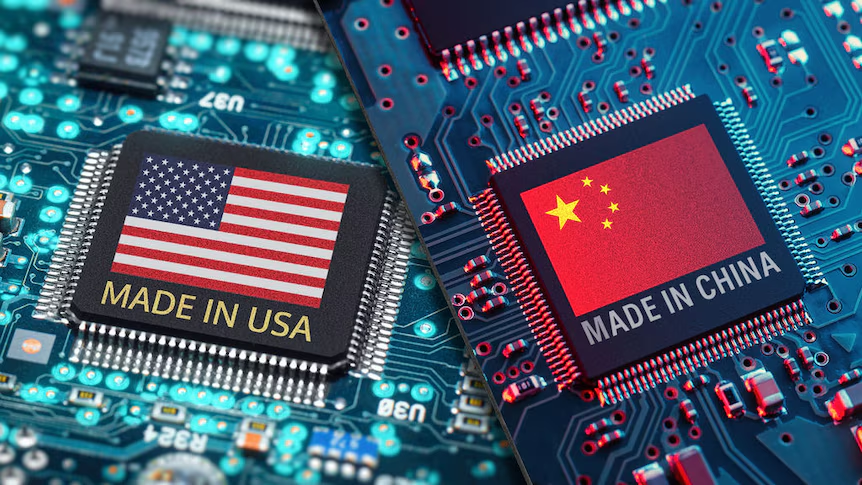
The U.S. push to reshore semiconductor manufacturing is gaining momentum, with major projects signaling a shift toward domestic technology self-reliance. Initiatives like xLight’s free-electron laser development and Vultr’s AI computing cluster demonstrate the country’s focus on building advanced infrastructure at home.
xLight recently received $150 million in government funding to develop next-generation free-electron laser technology for semiconductor production. The project aims to improve precision and efficiency in chip manufacturing, supporting U.S. efforts to reduce reliance on overseas supply chains.
Meanwhile, cloud computing company Vultr announced a $1 billion investment in an AI computing cluster in Ohio. Backed by AMD, the facility will provide high-performance computing resources for AI development, as well as semiconductor research and simulations, further strengthening domestic tech capabilities.
Analysts say these initiatives reflect a broader trend in the U.S. strategy to secure critical technology infrastructure. By investing in advanced manufacturing and AI capabilities domestically, the country can maintain leadership in semiconductors, artificial intelligence, and other high-tech sectors.
The semiconductor industry has faced global supply chain disruptions in recent years. Reshoring efforts aim to mitigate risks, ensure consistent chip supply, and support strategic industries like defense, healthcare, and technology. Projects like xLight and Vultr help achieve these goals by fostering local innovation and production capacity.
Industry experts note that reshoring is not just about building factories—it also involves creating a supportive ecosystem. Investments in AI, high-performance computing, and advanced manufacturing tools are crucial for enabling startups and established firms to innovate efficiently.
xLight’s free-electron laser technology offers precise and adaptable solutions for semiconductor fabrication. Its development can reduce defects and speed up chip production, making U.S. manufacturing more competitive. Similarly, Vultr’s AI cluster provides the computational power necessary for designing and testing advanced chips, supporting the next generation of semiconductor innovation.
Government incentives and funding play a key role in reshoring. By supporting high-tech projects, agencies can attract private investment, create jobs, and strengthen regional tech hubs. Both xLight and Vultr projects demonstrate how public and private collaboration can drive domestic infrastructure growth.
The momentum in reshoring also signals opportunities for AI and semiconductor startups. Companies working on hardware design, simulation, and chip optimization can leverage domestic infrastructure, accelerating research and commercialization.
As the U.S. continues reshoring efforts, initiatives like xLight and Vultr show how strategic investments can bolster technological independence. By combining advanced manufacturing, AI computing, and government support, the country is laying the groundwork for a resilient and competitive semiconductor and technology sector.
This growing focus on domestic capabilities highlights a clear direction: stronger U.S. infrastructure, greater innovation, and reduced dependence on global supply chains, ensuring long-term leadership in critical technologies.
